- Personal
- Business
- Home Lending
- Digital
- Personal
- Business
- Home Lending
- Digital
Account Login


Account Login
From the outside, a credit union and a bank can look a lot alike. Both offer checking and savings accounts, loans, debit cards, and Digital Banking. You can walk into either one and deposit a check.
The real difference is underneath: who the institution belongs to, and who it works for. That one distinction shapes almost everything else, from the rates you see to the way decisions get made. Here’s a plain look at how it plays out.
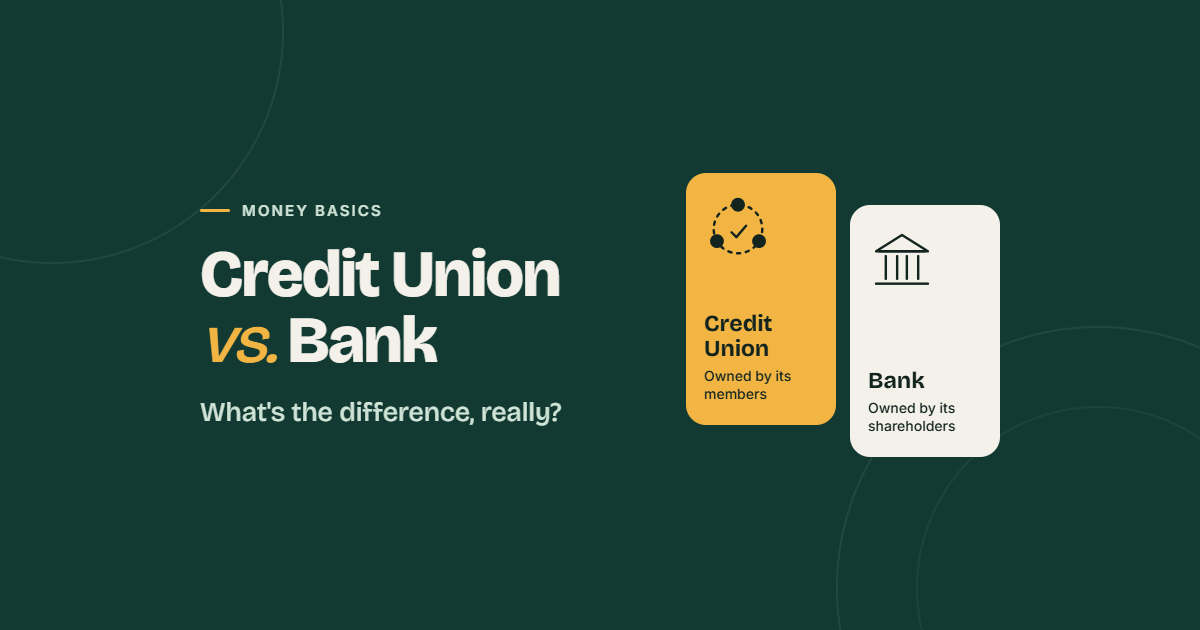
Most banks are for-profit companies owned by shareholders. Those shareholders may never set foot in a branch, but the bank has a responsibility to earn them a return.
A credit union is a not-for-profit cooperative owned by the people who use it. When you open an account, you’re not just a customer. You become a member, and the credit union exists to serve you.
So instead of sending profits out to investors, a credit union puts its earnings back to work for the people it serves.
Because credit unions are not-for-profit and don’t pay shareholders, their earnings often come back to members as better value. In practice, that can mean lower rates on auto loans, mortgages, and credit cards, higher dividends on savings, and fewer or lower fees.
Every institution sets its own rates, so it’s always worth comparing. But the model itself is built to favor the people on the other side of the counter, not investors.
Yes. Bank deposits are insured by the Federal Deposit Insurance Corporation (FDIC). Deposits at federally insured credit unions are insured by the National Credit Union Administration (NCUA), an independent federal agency.
Both provide the same standard coverage: up to $250,000 per depositor, per ownership category, backed by the full faith and credit of the United States government. Different names, same peace of mind.
This is one of the most common hesitations, and it’s mostly a holdover from years ago. Today’s credit unions offer the tools people expect: Digital Banking, mobile check deposit, online bill pay, debit and credit cards, and ATM access.
At Maine Savings, you can manage your accounts from your phone or computer and still sit down with someone at a branch when a conversation matters more than an app. You get the convenience without losing the person.
Credit unions tend to be deeply local. Decisions are made by people who live and work in the same communities as their members, not in a distant headquarters.
For Maine Savings, that means investing in the places we call home. Through the Beyond Banking Grant Program, local partnerships, and employees who volunteer in their own towns, we try to show up for Maine in ways that go well past a transaction. When the people making decisions know your town, it shows.
The best financial institution is the one that helps you get where you want to go. If you’re looking for a partner that puts members first, keeps decisions local, and treats your goals like they matter, a credit union is worth a closer look.
Curious whether Maine Savings is the right path for you? Stop by any branch, give us a call, or visit www.mainesavings.com to learn more about becoming a member.
Please be advised that you will no longer be subject to, or under the protection of, the privacy and security policies of the Maine Savings website. We encourage you to read the privacy and security policies of the site you are entering, which may be different than those of Maine Savings.